Sheryl Giesbrecht Turner



 YouTube
 The conversation explores the themes of God's love, forgiveness, and finding freedom through forgiveness. It delves into the power of forgiveness and the impact it has on one's identity in Christ. Additionally, it discusses the challenges and triumphs experienced in ministry, highlighting the importance of standing firm in faith during difficult times. The conversation covers the journey of overcoming cancer, facing tragic loss, finding hope and healing through faith, and embracing new beginnings. It also includes a powerful golden nugget from Hebrews 12:1-2, encouraging perseverance and fixing our eyes on Jesus.
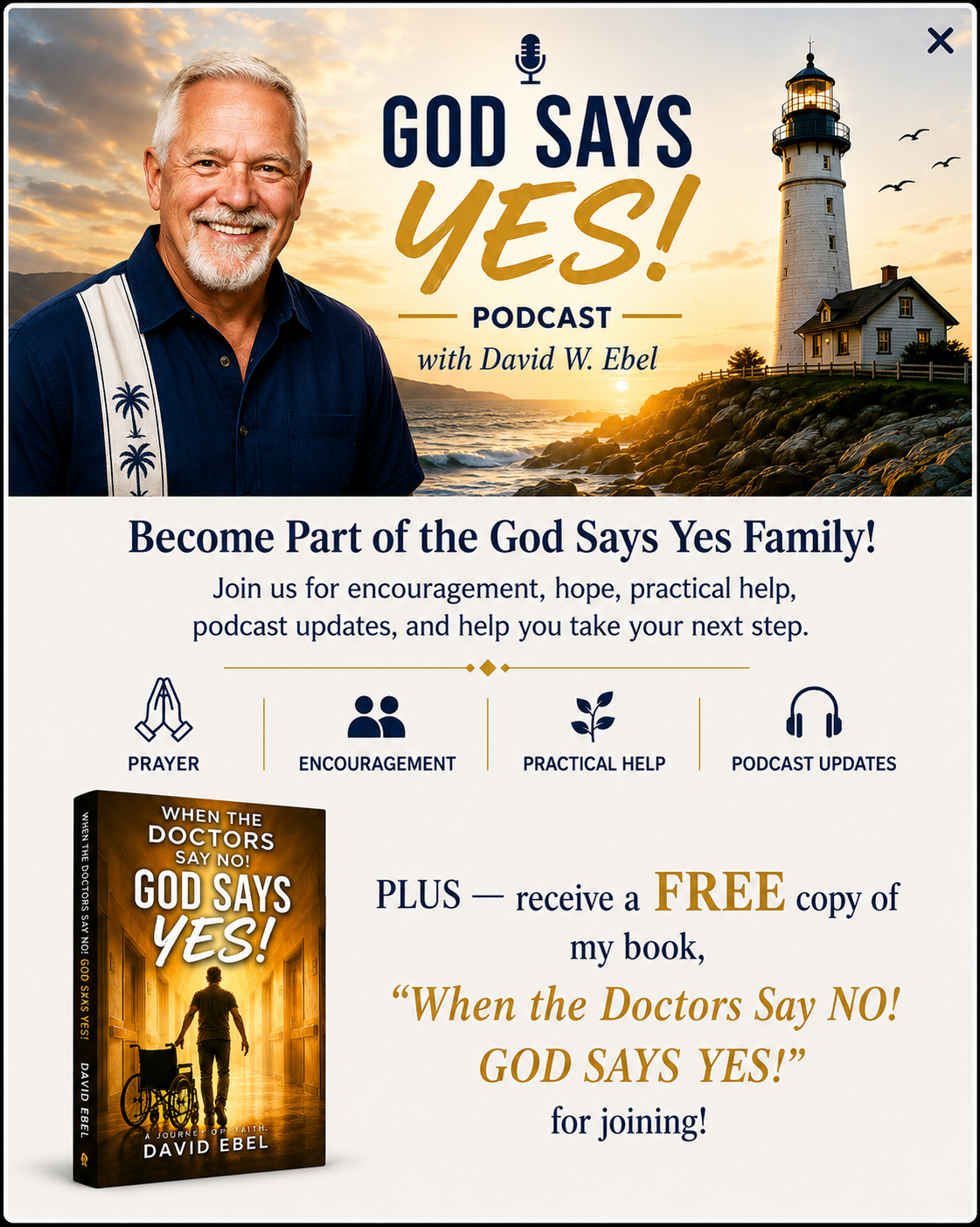
David W Ebel: Welcome to the God Says Yes podcast. You are welcome here. Welcome to another episode of God Says Yes. My name is David Ebel, and I'm your host. After 50 plus years of ministry, â God has really made it clear to my heart that we are to encourage those when they struggle. All of us struggle at one point or another, but when they struggle, we need each other. And so that's why this is God Says Yes. God says yes to you. When things are hard, when you've been betrayed or belittled or you've been hurt or you've been wounded, or or me even at church, somebody's acted out and not treated you like they should be treating you. God is still there. God isn't the people who act out. God is the one who turns the bad into good in spite of the situation. On behalf of the body of Christ, if you've been hurt in church, I apologize because that's not God's plan. â unfortunately, â for us who go to church. The church has really been â relegated to become the emergency room with the body of Christ. And so â when you bring if you go to an emergency room, not everybody going in is happy about being there. And sometimes when they go to church, they may say they're happy to be there, but they're miserable inside still. And as a result, they splash off the ugly and we some of us receive it. And â God will heal that and restore that and rebuild that, but you've got to want him to. And he would love to reveal himself to you. And show you how to move past that so you don't stay stuck. It's worse than gum on a shoe, â w when people wound you. It's hard to get rid of that if you don't have God's help. So â that's why we do what we do. And â we've ministered in forty-nine states and twenty countries, so â we've been able to share God's love wherever we've gone all over the world. And we're honored to have that privilege today. I have with me one of my dear friends. I ha we haven't seen each other in years, but you know, it's like yesterday because we God has given us a good family relationship. Her name is Cheryl Giesbrick Turner. Cheryl and I have known each other for almost I gotta be 30 years. And â she she did ministry in Bakersfield, California when I was the Salvation Army officer there. And we got to know each other really well from her radio programs and her classes and her teaching and her television and all the ways that she she's shared God's love with people all over the world. And so when we found out What we I found her and she found me. We we we committed to have Cheryl come on the podcast and just share his how how good he's been to her and and to you. So Cheryl, welcome. We're glad you're here. Thank you, David. It's great being with you. And Cheryl, for the for the sake of the new viewers, tell us about yourself. I am Cheryl Giesbeck Turner and live in Bakersfield. I I can't believe how many decades now it's been. I th it's going on four decades, so I'm two years shy of four decades, which is a long time, especially when I was a Southern California girl. When my first husband moved me up to Bakersfield from where we lived in Orange County when we met at our Biola University, there were fingernail marks up I five. Because I did not want to move here. But I've been happily rooted and thriving, bearing God's fruit in Bakersfield now for a very long time, and thankfully remarried to my husband Jim Turner. We â both were widowed and we married each other about 12 years ago. We have a blended family of six adult children. He has four who are married, and I have two who are married. So combined, we have a total of 15 grandchildren. â six of them live overseas. So we don't, you know, don't worry, we're not spending a lot of our hard-earned money on them or time. We just, you know, it's a lot of people to take care of. But thankfully, God brought us broken hearts together for healing. But I'm thankful to know and and for your listeners to know that you have a a a podcast such as this because people need to know. that when the doctors say no, God always says yes. And we we're grateful for you being here. That's the reason why we named it that is because at one point or another, you're going to get advice that that is not helpful. Sometimes from people who should be in authority and and and they they say the wrong things. How or or people you you trust because you've known them a long time and they'll they'll put their foot in your mouth. They they they'll they'll be harmful without even realizing it at times. But God has got a bigger plan than leaving us where we were. And that's why we're why we do this is because I don't want to see anyone stand before God and and God say, you know, I have better plans for you. I I I'm glad you're here, but I really had better things for you. I want God to give to show you those better things now, not then, so that you can have a fruitful life, a beautiful life. In spite of your past, your present and your future can be beautiful through him. So, Cheryl, this is your story, and we're glad you're here. Would you would you tell us your story? Yes, I'd love to. So I was one of those teenagers that were basically left alone because of my choices. I had become a juvenile delinquent by age 17, â four years running the streets of my town using drugs, alcohol, and all of the Types of illegal, immoral behaviors that go along with that lifestyle. But my the God that that loved me loved me more than I could even love myself in that condition. â I was raised in a Christian home, but we were not grounded. We were at a lot of different churches because my father had a wonderful job as an insurance salesman, but that required that every time he groomed his management team to the point that. They needed him in a different city, they would move us. And so what that meant for me, a person who doesn't like to start over, you can see by the â amount of years I've lived in Bakersfield, it's not I don't like I didn't like moving then, and I don't like moving now, although I've tried to get out of Bakersfield many times, but I do travel a lot. So but my point is here that every time my dad moved us to a new neighborhood, a new school, a new church. it was time for me to start over. And I didn't do very well with that. I couldn't â get friends. I tried all that I could to do to to try and fit in. And what I ended up doing at every place that I went was I thought if I can be one of the cool kids, or let me say, what I thought was cool, â try and fit in, then â then I would be, you know, everybody would know who I was. Well, they sure did know who I was for all the wrong reasons. The summer before my senior year of high school, I don't know if my parents wanted to get a good night's sleep or if they just wanted to load me off somewhere for the summer, but I was â told that I had a full-time job at a Christian camp up in beautiful Lake Tahoe. And so I was shipped off to this Christian camp and these camps People, the staff all knew who I was, what I was doing. And what was remarkable to me was that not only they didn't search my stuff when I got there, they didn't give me rules that I was gonna break anyway, â when I got to the camp, they just showed me what the real true love of God looked like. Because in my church youth groups, most of them them had told me, you know, you've gotta clean up your act, you've gotta not cuss, you can't smoke. You've got to get rid of that weird hair, those weird clothes. You can't act like that when you come into our group. But at this Christian camp, they loved me. In fact, the first day on on campus at this beautiful camp, they had me doing chores in the dining hall. I was with the camp director's wife. She told me, here's how you do dishes. And there was a â probably sky high. It seemed like probably I was hallucinating from some of the drugs I took. But there was this pile of dishes, and she explained to me how to do the dishes, and I was like, I'm not doing these dishes. And I proceeded to give her a piece of my mind and my tongue. And I walked out, cussed her out and walked out, and told her, I'm not doing that. So but I heard something follow me. It was a phrase that I will never forget. It was a phrase that I heard day in, day out for the next several weeks. As the Lord softened my hardened heart, it was love covers a multitude of sins. And this woman spoke, love covers a multitude of sins. As I walked out the door, she didn't say, Hey, you stop. You can't, you can't leave. You gotta get do these dishes. She spoke, Love covers a multitude of sins. So again, I lot I left the dining hall. I went out and probably smoked something. but when I went to bed that night, I thought, man, that made me so mad. What she said was Love covers a multitude of sins. Well, the next day the same thing happened. I wasn't in the dining hall. This time I was doing a different chore, a different part of the camp. And one of the other staff members said the same thing when I refused to do my chore. I kicked a log, I even kicked my dog and I know I'm a dog lover and I can't believe I actually was that mean to animals, but I I was just so angry inside I didn't fit in anywhere and I was trying so hard to fit in. But anyway, I just didn't like anything about myself, my life, my circumstances. Kicked the dog, walked away, and I heard that phrase again. This young man said, Love covers a multitude of sins. Same thing happened next day, several times a day, and I thought, man, these people have got. To be loaded. These people have got to be all on hallucinogenic. You know, LSD was really, really popular when I was a teenager. They've all got to be using LSD acid. They've got to be smoking something, or either that, or they have little sticky notes on all the pine trees and they're all in cahoots. And these people are making me so mad. But when I was thinking about what they said, love covers a multitude of sins. They also acted accordingly. And this was very different for me because most of the other Christians that I'd been around, they wanted to, you know, make shame me into good behavior. And you know how that works. It doesn't. It never works. So at the end of two weeks, you know, I said it took me several weeks, but actually it was the Lord that â softened my heart at the end of two weeks. And these people, they just loved me. They didn't see the way I looked or how I acted. They didn't ship me off to home. But they loved me literally to the Lord. And so there I was one night in my cabin. â I had a cabin by myself, and I was in my sleeping bag, and I realized, you know, I'd been trying so hard to clean up my act. I every probation officer, every â advocate, every counselor that knew. My parents or me in the town that I grew up in knew me and all of these people had not helped me. And yet that night I realized I had been trying to do this on my own, that I didn't have to clean up my own act, that God loved me just the way I was. And that's when I realized the love that this woman and everyone else had been talking about. The love that covers a multitude of sins, that my sin was not too much for God to handle. That God's love could cover. every sin that I committed. And so that night I committed my life to Christ. I was 17. It was the summer before my senior year of high school. And I committed my life to Christ that night on my own. I knew what to do and I finally had decided I can't run my life anymore. I'm not going anywhere valuable. The year before that I'd been locked up and in fact I was arrested many times. But the only time that I was locked up, my parents left me there for â a night, and that was enough for me to understand the consequences. And that's what when the â when the counselor released me that day, he said, You know, you need to make some choices here. You're gonna either end up locked up for the rest of your life or you're gonna end up dead. And yet still that was a year before the summer of my senior before my senior year of high school. So that night I accepted Jesus Christ as my Savior. He became Lord. â I went to the staff meeting the next morning as I'd been doing for the last couple of weeks. But that morning was different because I knew that I wanted to tell them that God had made a difference for me and that there I don't know if how I could explain that they loved me to Jesus. But â there I was in the staff meeting and I prayed in the staff meeting unlike I hadn't done that before. That was my first prayer as a new Christian. And I remember that I in my prayer I said a cuss word because that was how I talked. And they all were they jumped up and I thought, â no, now I'm in trouble again. But no, it was that they were so overjoyed with the fact that that God had gotten a hold of my life and that I had accepted Jesus as my savior and Lord. And let me encourage those of you who who wonder if you're too far gone or if you've committed the unpardonable sin. You know, the script are the â the phrase that they quoted over me, it's a scripture. It's first Peter four eight, and it's love covers a multitude of sins. There is no sin, no person that is too far gone. And God is enough. God's love is enough. The blood of Jesus took your place. He covers, his blood covers a multitude of your sins. And that, my friends, is grace. And I thank God that through God's word, that's what set me free. And through his people who showed me the love of Jesus, that's why I'm here today. Cheryl, â one of the things I noticed and we when you told it is is about the About â God covers a multitude of sins, but there may be somebody who's even confused what sin is. â I was twenty before I found out what it was. Nobody had told me. I had certainly done it, but I didn't even know how to define it. Sin is when you know it right is and you do the wrong thing anyhow. You willfully go opposite of what you know it right is. That's a sin. Because that w that rebellion separates you from the God who created you to love. And so There had to be some way for that sin to be r removed out of the way, or we would never get to God. So that's why Jesus came, lived a life without sin, and then allowed himself to be crucified and shed his blood. So the shed blood of Jesus washed away our sins. So when God sees us, he sees us through the filter of the blood of Jesus, and there is no sin. We're free of it, just like you went made free when you went when you got in that sleeping bag. And you talk to Jesus honestly, and he revealed himself perfectly. Amen. So tell us more. There's I that's not the last that's not the last chapter. That's the first chapter. Yeah, so â God gave me a passion for his word and his people. I went on from there to graduate from high school, which was a miracle in itself because I cut so much school during the three years prior. â my teachers helped me. I get all my credits lined up. I graduated with my class, and that was just amazing that the Lord allowed me to give him glory through getting through and finishing well in high school. So then I went on to Bible college, went to school in Portland, Oregon for a year, and then transferred the following year to Biola University. And that's where I went for three and a half years, and I met my first husband, Pastor Paul Giesbrecht. We were involved in ministry in Youth for Christ Campus Life. We were both on staff with Youth for Christ Campus Life. I was the first female staff in â Orange County. I â thank God that God allowed me the opportunity to work with the body of Christ to understand how to fundraise. You know all about that and and it's something that it's kind of in my in my root system to be a thankful person when God's people â God moves in their hearts to donate their hard-earned money to a cause that they believe that God is really using in â in the body of Christ, whatever or in you know outreach, whatever it is. So when Pastor Paul and I moved to Bakersfield, it was because his father had been diagnosed with kidney cancer. And he and I were very happily living in Orange County â with our college friends still working in in Youth for Christ. And when he told me that I would be moving up to Bakersfield, I thought it was a place that you just stopped on your way to where I had been raised, which is Davis, California. And I thought it Bakersfield was just a place that you stopped to refuel your car or get a hamburger. And I didn't really know that people lived here. So when â of course we got married, so I I understood that was where he was born and raised not born, but he was raised here. Most of his life he spent here. So when we moved here, we moved in fog. It was, you remember the Thule fog fog here in Baker's David. And so it was a sunny day in in Orange County, eighty-three degrees, and we moved here in in January, and it was thirty-eight degrees â back in the day where There was still Tulli fog. And they had this weird thing going on called fog delays. And I'm like, what's that? Fog delay is when the buses can't move for two hours because it's so foggy that they can't see. So I was not a very happy camper for a few years when I first moved here. But what God showed me is that I had a lot more lessons to learn. There are many lessons to learn. Would I learn them or not? The first one that we learned with we didn't want to learn, but we learned how to bury a parent. And that's because when we moved here in January, Pastor Paul's father, Ben, â passed away the following December. And that was a very difficult time for our family, but we realized that God moved us up here so that we could support his mother, who was now newly widowed, and his sister's Who were one of them was younger and the other one was already married. But, you know, it's important to understand that's one of the reasons why God moved us up here. But again, pivoting and learning how to find new jobs and new ministry opportunities was again difficult for especially Cheryl, who didn't like relocating, didn't like starting over. Plus, I had the beach and my college friends in my previous living situation with Pastor Paul when we first got married. So, but we both got involved in ministries. I got involved in Bible study fellowship and prayer groups. I learned â so much about God's word through studying the Bible. I â gained a lot of women friends who were farther along down the road as a young mom than I was. Again, we had only been married a â couple of years, I think three years before we welcomed into the world our firstborn daughter Sarah. And then again, about Three and a half years later, our son Ben. During that time, we had a difficult time â finding our spot in ministry until we settled into a youth assignment where Paul was a part-time youth pastor and he was also working in his own businesses. He had several that he was running. And â we got very settled into it, it was the church that Paul served in when he was growing up in college. He was basically going back and forth on weekends, being the youth pastor to the college students. And so the same church asked him to help them out. They said, you know, help them out with junior high and high school, which he was willing to do. So we were there for about three and a half to four years and really enjoyed it. Of course we met through Youth for Christ, which is high school students campus life. So I worked with the young women in high school. Some junior high too because it was a smaller church. But again, we were very we we were thriving. We then had our â our son who was just under eight months old and our daughter who was about four. And then one day we were getting ready to go over to the senior pastor's house that that evening for dessert. And I was actually baking a pound of brownies and I we got a phone call and I wasn't on the other end of the phone, but the phone that Paul picked up was a landline. You remember those days? â I right in the same room that we were in, that I was in, and I heard Paul pick up the phone and say hello. And I heard our senior pastor's voice on the other end say, Hello, Paul. Don't bother coming over tonight. I'd like to have your resignation on my desk tomorrow morning. Hung up the phone. And we're like, what? Yes. So Paul was fired for no spiritual or moral or illegal reason. â we found out later, you know, what you got was basically what we were told to do. And that was and it ended up being the next four months of the church telling us. What to do, what to say, what not to do. But basically, we were asked to leave the church and Paul was fired from his pastoral position. We found out later, almost a year and a half later, that it was because the senior pastor wanted to bring in his best friend for Paul's job. So Paul had to be removed from the job. My point in sharing this story was because we were a young couple who were very excited about ministry. We had a young family and to have basically the rug pulled out from under us in every way. Not only did Pastor Paul lose his income, I became the sole supporter of our family with a part-time job that I wasn't good at and I didn't like. I was a daycare provider and daycare and Cheryl were like oil and water, did not go well. I did it because I wanted to be home with my kids. So as we were asked to leave the church, you can imagine we not only lost our income, we lost our spiritual family, we lost our ministry, and then our own biological family. Most of them attended that same church. So you can imagine that kind of we were reeling. We felt like not only it was an emotional and relational divorce. I've never been divorced, but for some of you guys, That are listening who have been divorced, you understand it's like a ripping and tearing. I I've heard that divorce is like if you try and remove a piece of tape from a piece of paper, it pulls off half of the paper. And usually it doesn't go well because it pulls apart everything and it can't happen. So when we were told to leave, â we were given a four-month â notice, which was horrible. And Paul for the last two months wouldn't. Go wouldn't come to church, which I don't blame him for doing that, but his responsibilities were almost removed immediately. And then for me, my kids, my daughter, in fact, was involved in the children's program for Christmas. It was at Christmas time. What a great Christmas present, right? So to have to go and show my face to these people that some of them I knew who were for us and who were against us, terrible at the church. It shouldn't be that way. And that was my thing was how can these Christians treat us like this? It was not a very happy time for us at all, let me tell you. We were so mad, we were so bitter. And as we left that church, part of the severance package included our daughter still being going to preschool at the church because it was a church and school. And so literally I had to drive her to church, I mean, drive her to the preschool, drop her off and pick her up. Because of course I wasn't going to make my husband too suffer through that. â but when I went, you know, I really was tempted to drive my car through the senior pastor's office. I'm serious. That's the kind of person I am. I'm a mean, I'm not very nice. But just because when you feel that bitter and you feel so angry, what do you and I want to do? We want to take revenge. We want to punish those people that did this to us. And that was me. We were so bitter, angry, and full of revenge for up to I think it was about a year before we had not only started attending another church, but we also found out about a seminar that was going to be hosted at the church that we were attending. And a guy that we had never heard of was gonna be speaking on resolving spiritual it was resolving personal and spiritual conflicts. And the man's name was Dr. Neil Anderson. Well, when Paul and I were at Biola University, Dr. Neil Anderson was one of the professors at the seminary at Talbot, which was nearby. And some of my classes for Christian Ed were in the Talbot wing where so I knew who he was, but I also well I just said I didn't know he who he was. I knew his name, but I didn't understand his ministry because we didn't I guess didn't need it or didn't, you know, have an encounter with it quite yet. But God had a plan in bringing us to our new church and and Dr. Neil Anderson was bringing his seminar there. So we went, we signed up for the conference. It was a Friday night and a an all-day Saturday event. On Friday night, Dr. Neil Anderson explained about what resolving spiritual And personal conflicts was all about. The first thing that he explained was what is our identity in Christ? Our identity in Christ is something that we as believers have a foundation on. It has to do with the finished work of Jesus. You talked about the blood of Jesus, and that's what covers our sins. But us that in Christ. The moment that we became a Christian, everything changed. All things are passed away. Behold, everything has become new. That's 2 Corinthians 5 17. And so what Dr. Neil Anderson discovered as he was training Talbot seminarians is that many of these guys that were coming to seminary to be pastors, they didn't understand what identity in Christ is. That although they were new creatures in Christ, they were living As if nothing has changed, because that's where the enemy wants us to be. Our enemy wants us to remember what we have done. He wants us to live in our past, bring up our past offenses, think that Jesus can't cover our sins because they're too much. It's my sin is too much for God to handle. And we know that the blood of Jesus has covered a multitude of sins, that without the cleansing of blood, there is no forgiveness of sins. And that's in Hebrews. So when Neil Anderson was explaining identity in Christ on Friday, he also gave us homework for the next day. He said, tomorrow morning, what we're going to do is through a prayer process. It's called The Steps to Freedom in Christ. It's seven areas that the enemy can gain access or a foothold on you as believers. And we're going to take time and pray through these seven areas. And there were pamphlets that he handed out, booklets, prayer booklets for us. That were handed out the next day. But what our homework was for that night is to go home and make a list of all the people that God is asking us to forgive. And when he said that God is asking us to forgive, I thought, â man, I'm not gonna do that. I can't do that. I don't wanna do that. And so that night, what happened? You you who are married, you probably know how it works. My husband, Paul, Pastor Paul over here, he's sitting down to do his homework. And I'm like, â brother, here he goes. He's doing his homework. I better act like or at least pretend like I'm doing mine. So I sit down and I start thinking, okay, God, you're asking me to forgive these people. Who is it that I need to forgive? I started writing down names. I started with five, ten, twenty, thirty, forty, all the way up to seventy five names that God was asking me to forgive. And I didn't look at Paul and say, what, how many do you have? Because I thought, you know, here's my chance. I'm ready to offload all of this. If this is if this is really gonna work, because I was really skeptical. I thought, this is not gonna work. This, no, I don't know how this can be. If God's asking you me to forgive this, then what is he gonna do? You know, take my list from me. I don't know. But I wanted to see if it would work. I didn't have anything to lose, right? So we go back the next morning. We go through each one of the the seven areas. And the third area is finding freedom through forgiveness. It's called bitterness versus forgiveness. And when I looked at the title where it said bitterness versus forgiveness, I thought there is no middle ground here. Because I was so bitter. I was so angry. I was so hurt. Because Christians shouldn't act like this. They shouldn't do these things to people that are in ministry. But when Neil Anderson introduced the whole prayer time, he said, What I want you to do is this is a private prayer time between you and God. And this was a big sanctuary that seated, and it was on pews, not chairs. So it could seat up to 2,000 people. And there were about 250 of us at this conference, which was back then a lot of people. So he said, I want you to spread out. This is not between you and anyone else. I want you to make your pew an altar if that's what God is asking you to do. And so I spread everything out. I knelt on the pew, I mean, below the pew. I had my Kleenexes, my list, my prayer book, and I asked the Lord to Show me who to forgive. And he had shown me in the list, but there were more than that actually on on that day, because once I started praying, the prayer that he taught us, it was a prayer that goes like this it goes, Dear Lord, I choose to forgive. And then you fill in the person's name. It made me feel, you go back to that situation, whatever happened, and for me it was. I choose to forgive Pastor, and I won't share who it was, for â firing my husband, my the sole supporter of our family, Pastor Paul. â it made us made me feel like unnoticed, it made me feel overlooked, it made me feel unimportant, it made me feel humiliated, it made me feel embarrassed, like we did something wrong, it made me feel. slighted, excluded, and then the list goes on. And there's a list of words that that when I encourage people to do the same prayer time, â a list of words that we share that are emotional words. And no, this person didn't make you feel, but the circumstances that happened are very important for you to be able to feel that emotion because unless forgiveness visits the emotional core. It's incomplete. It's not like saying I'm sorry. It's basically rolling this burden onto the able shoulders of the Lord. And I didn't know how to do that. I never had been taught anything about how to forgive those who have hurt me. And that's one reason why my list was so long. So then you forgive them for making you feel, and then you say, I choose to bless them. Now That might seem like a minor thing, but you know, that for me was a very difficult thing to do because I wanted vindication. I wanted these people to suffer, like we did. But then when I realized that God tells us in his word, judgment is mine, saith the Lord, that there is no amount of punishment that I could give them that would be enough anyway. But God would hold them accountable and responsible. For the pain that they have inflicted. He knows all about it. And you know, those crucifixion wounds that Jesus endured for each of us, those wounds belong to me. And those were the ones I inflicted on him. And he has felt every single bit of pain that you and I have felt in church hurt, in any of these other things. So back to the prayer day. As we finished that day, it was exhausting. It was freeing. It was also a great teaching time for us, for Pastor Paul and I to realize that we did not need to allow the hurt that those people had dumped on us to hurt us any further because it was the enemy's trap that had us into a place that we felt like we we were â helpless. And that's what the enemy wanted for us to feel helpless. So letting go of our church hurt was the beginning of healing our heart. Don't you know that we had many more opportunities after that? But within about a year after that, Pastor Paul began serving at the church that we were attending, that we had this conference, and we actually were able to help other people to find freedom through the steps to freedom in Christ. And that's what this prayer time was all about. Awesome. Pastor Paul. He ended up going on staff there. He was the â kind of like the executive pastor, not the main pastor, but he was over the college group, the youth group, the small groups, the â all of the support groups. We ran grief share, we ran divorce care, and we ended up implementing the Freedom in Christ support group. And it was very helpful with people who had gone through divorces. Wow. I some of those things that you're talking about, I â You know, I've been at this a long time and and I've never heard how to apply those. So if I haven't heard, a lot of other people haven't heard either. And I know that many times in our ministry we've had to t say to people, the this that you're carrying the you know, the person you've that that you need to forgive doesn't it they're they're they're busy. They don't even care anymore. They're they're in another another chapter. And you're sitting here tied up tied up, miserable, and it it's poisoning you. And we gotta find a way to get the poison out of you, and the only way to do that is is Jesus. And but the the steps that you're talking about would be so helpful in that process of helping others. So I'm I'm grateful you're sharing that because there's gotta be someone listening or viewing who who this will speak it resonate to them and they'll they'll be pursuing how can we do this? I thank God for the opportunity to share it. It also helped me. as a young mom, I struggled with depression. And so the church hurt was one part of understanding how to find freedom, but also how to find â more recovery from shame and blame and â and I couldn't forgive myself. Although I was a pastor's wife, I had prayed for other people. I still had thought that I'd committed the unpardonable sin. Not only â did I have a problem â thinking about what what I had done in my past, and I think sometimes what the enemy does, not not think, I know what he does is he reminds you in a time of ministry that when you're helping someone else, that you you hear a small voice. in your head saying, Who do you think you are? You know what you did, and I do too. And so that was one of the reasons why I began working with women and understanding that especially young moms when their hormones are all out of whack. It's â and then for women who are going through changes as we go through, â when you move or you change churches or you go Into a different ministry than you've been in before, we need stability. We need to know our identity in Christ. We need to remind ourselves how to find freedom through forgiveness, but also how to stand firm in a time when we don't feel we feel everything shaking. We experienced that during COVID, don't didn't we? Everything was shaken. And so â to understand how to stand firm in Christ and with Him at our side. We don't have to worry that he is able to stand beside us and give us the strength that we need. Now, Cheryl, you've those are incredible steps, but there's more chapters. Yes, yes. So I was talking about â a little bit about my depression, which was why one of the reasons why I wrote my book, Unraveling the Lie Knot, which we'll be talking about towards the end. But it was for Women who are our young moms who may feel like they're tied up in knots because of things that they believed. Maybe their family of origin talked down to them. Maybe they did they were told, you know, you're worthless, you'll never amount to anything. That's one way that we can get tangled up in lies. Another way is that when we feel like we've got to measure up to other women, which was one of the things that I did as a pastor's wife. I thought that I always had to be on target, â have the the most well behaved children. And then the Lord just reminded me that I don't have to put up with, you know, being entangled with the lie of perfectionism. Another thing that â happened to me was one day I found a lump underneath my left eye. And I don't know if you and Diane were still or you were already in in Bakersfield yet, but My friend Dan Schaefer, I was volunteering at the time. I hadn't started working for KXL radio. I was volunteering as coordinator of the day of prayer and I found a lump underneath my left eye. After about four weeks of tests, biopsies, CAT scans, and a PET scan, which is a radioactive dye, I was diagnosed with stage four non-Hodgkins lymphoma. It's a blood cancer similar to leukemia. It was in in the lower lymph node of my left eye, which which meant that that that's where the lump was. But then some of the other tests, the the PET scan, a radioactive x-ray, showed that it was not only in the lymph node of my lower left eyelid, it was in the bone marrow of my right arm, my shoulder, my elbow, and the femur of my left leg. So basically I was full of Stage four, non-Hodgkin's lymphoma. And as I was facing that time, I was very fearful. Fearful because of an unknown future, fearful because I didn't understand what was going on. There was no cancer in my family. There was in Pastor Paul's family. His dad and his grandpa both passed away from it. And basically I wondered, God, have you got the right geese brecht? And as the doctor showed me my x rays, I I really I couldn't believe it. I was like, I could tell by the way that my my shoulders were on the x-ray. They were my films, but I just so after you know how it is when you get a diagnosis that you're like, what? That's mine? Are you sure? taking a deep breath, I â knew that God had a plan. I just had to understand, you know, what what was the next thing to do. And that was when I found out that all God wanted me to do was the next thing, which day in, day out ended up just we had a son senior in high school that year. â the next thing was to get him ready for school every day, to start my treatment, to â continue to do what I could do at home, but I had to pull out of all the ministries. At that time I had written two books. I wasn't able to feel the energy to go speak. I think I did speak once or twice, but it was just a small thing where I was sharing around like a coffee table like we're doing today. So when I faced my â prognosis, I did something that I don't recommend doing. I went online to find out what the â outcomes could be, and I found out that my prognosis was not good at all, that it was like an 83% success rate of the chemo working. But when they told me that I was gonna have eight rounds of chemo that would last nine months, that I would â basically be having all different types of side effects. that I didn't understand, didn't know, didn't want, that I was told I shouldn't eat sugar, I shouldn't eat certain things during certain times of the month because the chemo was working extra hard right after, that I should be â able to rest a lot. And that for me as a busy active person was gonna be very difficult. So I decided, you know, Lord, if I have you with me, then I'm going to be just fine. And that was the season that I chose to study the names of God. Jehovah Rapha is the Lord who heals. And so basically what we decided to do was trust the Lord with whatever healing outcome he chose. You know, I decided, a man, if you know, it says in the Bible to be absent from the body is to be present with the Lord. And I'm ready. Lord, if that's what you want me to do, then I'm ready to go. But again, it seems strange because I'd just been able to teach and speak more internationally and nationally. As you know, I'd been doing just what I shared with you about finding freedom through forgiveness, bitterness versus forgiveness, explaining identity in Christ. And that was important to me for people that didn't know about it, to learn about it. And here it was, it seemed like everything had been. Leveled. Everything had been changed. And I had no control over any of it. And so then I realized, you know, Lord, I mean, to myself, and I prayed, Lord, whose life is this anyway? So at the end of the nine months, I had many churches internationally and of course in the United States praying for me for my healing. And God praise the Lord, He healed me totally and completely from stage four. Non Hodgkin's lymphoma. It's been 20 years now. It's amazing that he chose to heal me, but I also believe that he kept me like that tenth leper. Remember, Jesus had those 10 guys that came to him and asked for healing, and only one went back to thank him. And so I want to be that one leper that goes back to thank the Lord for my healing. Because again, I say, Lord, whose life is this anyway? It's his life to use in whatever way he pleases. Amen. Thank you for sharing that. People who've been struggling with with cancer or another life debilitating â disease of some sort, â I can tell you having medical issues of my own, it becomes very hard. And it's at times â the enemy will play with your mind and tell you you know, there's no way out, you might as well give up and die. You'll you'll hear all kinds of false lies. And the internet is certainly one of those voices. â if you want a doctor, you don't find it within it with a website. You find him you f you you gotta send you somebody that's really in invested in you. So I'm I'm excited with what you're telling us, but there's more. Yes. â basically too, I'm working on a new book. It's called You Are Not What Hurt You. And what you're saying is that's why it's so important for us to understand what are or what it what it means to understand our identity in Christ is those things that come in our lives are not our identity. For me being a drug addict or a I'm saying an overcoming addict, â and then a cancer survivor. The next big thing that God showed me that I didn't have to use as my identity was about five years after my cancer healing. â Pastor Paul had been my caregiver the whole time. He drove me to most of my appointments to my chemotherapy, and he was with me for every diagnosis, every doctor's appointment, except for maybe two or three. And I was speaking for a local church nearby here, about 45 minutes out of town. It was a day retreat, and I drove my car up that morning Pastor Paul rode his motorcycle up to the campsite at the end of the day. And the the group had given me a room at this beautiful retreat center. So that after I got done, if I wanted to spend a little bit of time there, take a rest. And that day we got done with our retreat early. So Pastor Paul was coming up and I called him before he left Bakersfield to say, if you want to just stay home, you can or you can come up. I'm going to take a nap. 'Cause they gave me a room and I'm gonna use it. So he said, â no, I'll be there soon. So I took my nap, I got up and I heard his motorcycle, I heard those loud pipes. I heard the pipes and they woke me up and I jumped up and I'm like, Okay, here he comes and he's walking down towards me and I thought, Here's my amazing husband. Look what God has done with us and through us, twenty-eight years of marriage. I thank God for the opportunity to have him there. We walked around that retreat center for two hours and we planned, we prayed, we committed the future to the Lord. I just spoke in on Jeremiah twenty-nine, eleven and twelve. And many of you guys know that scripture. It's for I know the plans I have for you. Plans to give you future and a hope, not to not to harm you, but to prosper you and give you a future and a hope. I think I messed the middle up, but you you know, plans to prosper you, not to harm you, plans to give you. A future and a hope. We walked around that day planning, praying, and then we we had a missions conference to go to the next day. So we decided to go out to dinner here in Bakersfield at a wonderful Mexican restaurant. I got in my car. Remember, Paul had driven his motorcycle up. He loved his motorcycle. In fact, I sometimes called her the other woman. That's how much he loved her. Anyway, he he was love to be out on his motorcycle. And he had parked behind my car, and so he pulled around me. And as he went around a curve, he was out of my sight. I got in my car, pulled out. I should have seen him around that curve that I just mentioned. And you know how you do when you look straight ahead and you're following someone and you anticipate them to be. nearly in front of you, within sight. And I looked straight ahead as I rounded that curve and I was like, Where did Paul go? And I turned my head slightly, saw something sparkly like metal out of the corner of my eye. I turned and I saw a motorcycle laid out on its side. And I went I flipped my car around thinking, I think that's Paul. I didn't know, but I wondered if that's I had like a gut pinch to the stomach and turned around, pulled up behind the bike that was down, and I saw that it was his bike. And I looked all around and I didn't see him anywhere. I looked on the other side of a barbed wire fence, and he somehow had flown over the fence and he was face down, probably about 500 yards from me. So I jumped over the barbed wire fence, went to him and I noticed thankfully, although he was face down, his back was still heaving up and down. I'm like relief he was still still breathing, still with us. But of course you can imagine the shock. And I'm still thinking, what am what am I gonna do? This was a remote area, no cell phone service up there. I looked around and we were basically in a field. There was a small cabin nearby. I ran to the cabin thinking maybe somebody would be home because it wasn't that far for me to go and I didn't want to leave him because he was still breathing. But I pounded on the door, nobody was there. Then I thought, I've got to find help. And my phone wasn't working. What am I gonna do? So I prayed and I said, Lord, I'm standing there above him, screaming, Lord, what do I do? I can't find help. There's nobody here. And so then I thought, I'm just gonna pray, Lord, heal him, go to the edge of the road, trying to waving down cars, but this is a remote area. Nobody is driving by. Finally, somebody comes. It probably was not more than five to ten minutes, but it seemed like an eternity for me. So then I'm like, okay, Lord, help me, help me, help me. I told them, you guys, I need help. Could someone call 911? So someone did. In the meantime, the the people of the town started coming. â and it took about 45 minutes for the first responders to get there. And basically, it was from Bakersfield. The Bakersfield Fire Department was the first responders. When they got there, they rolled Paul over, put him on a gurney, opened up his shirt, and they ended up telling me, ma'am, he has so many injuries. multiple traumatic injuries after they trached him, put a tube down his nose to help him breathe. â they said, we're gonna need to call in an airlift for him because we don't have the capabilities to to help him anymore. We don't know the extent of his injuries, but we are seeing that he's having a lot of trouble breathing and he never regained consciousness. I knew that because I could see him. So Another forty-five or so minutes before the hair helicopter paramedics came and they landed and they told me you're not allowed to go with him because we need â we we can't handle the wait. And then I found out later that it was also because people â when they're working on somebody, if they need to, it's usually not a good idea to have the family member with them. So So they airlifted Pastor Paul and I â was told to drive down to where I could find cell service until they let me know which open bed they had for him. It would either be Kern Medical Center in Bakersfield or Antelope Valley Hospital in Antelope Valley. Both of those were trauma units. And so I drove another 45 minutes and waited for them to call me. Again, I had cell service down there and I didn't want to call anyone else until I found out what I was going to be doing or what was happening. So also my cell was running out of juice. So I had to be very careful with that. So they called me and they said, ma'am, we're gonna we have an open bed at Antelope Valley Hospital. So I called â his mom and my children and I told them that I was gonna be driving to Antelope Valley Hospital and I asked them when they called me I wanted to know the condition of Pastor Paul and they wouldn't tell me. As you know, they won't on the phone. So I drove another two and a half hours to Antelope Valley Hospital. This was at by the time I got there, it was eight PM. And all the while I was praying along the way, Lord, I know you have a plan, plans to prosper me, not to harm me, plans to give me hope in the future. And so what way is this going to go? I knew if Pastor Paul would have lived, he would have a long road of recovery, and he wouldn't like it one bit. He loved to be active, he was always doing fun things, and the road to recovery would be horrible. But again, did I want to be a widow? I was 52 years old. Did I want to be my life? We'd already planned out what our life would be like. Remember, we had those two and a half hours, Lord. I was really wrestling with what God's plan would be for me. Then I get to the hospital, I walk into the reception area. And you know, usually as pastors' wives, or you know, chaplain David, you would be able to walk right into the patient's room. But the receptionist, I said, I need to see Paul Giesprecht, Pastor Paul Giesbrecht. She acted really weird when I said, I need to see Pastor Paul Giesprecht. And she said, just wait here, ma'am. And I knew at that time, I knew it wasn't good. She shuffled me off to a little, not private room. It was one of those places where they have fabric with poles, no privacy. But they closed those they closed me into that little area and two doctors and a nurse came in. And they said, Ma'am, your husband didn't make it. And I screamed and I fell on the floor and I wailed. And I said, No, I scream so loud I'm not gonna do it here. I screamed No And I think everyone in the hospital heard my cry, my wail, my anguish. And they said, ma'am, your husband didn't make it. He had a heart attack in the helicopter. They used the paddles on him, but he didn't make it. And those words he didn't make it echoed. I I was like, No. No, it's not true. Take me to him. So they took me to him. And he was covered with a sheet, he already had a tag on his toe, and yet when I held his hand he was still warm, and there was blood dripping off of the edge of the gurney because of the open wounds some of the things that they had put on him to help him breathe and the other procedures that they do to try and revive life, but he still had all the things stuck on him. And yet I still had that last handheld moment with my first husband, Pastor Paul, the love of my life, literally. Twenty-eight years of marriage, my college sweetheart, we'd been into each other's lives for thirty years. And now he got to go to heaven first. How dare he? Really, it was. My cry of anguish turned to anger. I'm like you're kidding I'm kidding you're kidding me. After I overcame death and now you now you I have to let go of you So I made phone calls and as you can imagine. God had to come in in a more powerful way than ever before. I learned to overcome my addictions, my strongholds were broken free from the ways that I'd used to cope as a teenager and young adult through chemicals, through activities, through perfectionism. God helped me overcome my depression, my church hurt. I learned How to receive treatment for cancer as a patient. And now I had to learn something new. I had to learn a journey, how to be in a club that I never wanted to be in. The club was for widows, and I was 52. And here I was given a widow card. I didn't want it. How do I get out of this place? But yet the Lord had more to teach me about grief. about understanding and David, you w you and I both had gone through the training that Norm Wright offered. I'd been through it many times, but when you actually walk through it as a widower, as a widow or losing someone really close to you, it it's different. You have to apply the things that you taught and you have to really stand firm on the promises of God. That yes, Psalm 23 is not only for funerals, but it's for me personally. Because it really helped me to know that that I could walk through the shadow of the valley of the shadow of death. And that it wouldn't be by myself, that Jesus would carry me on his shoulders. His gentle I'm he's my gentle shepherd, and I was this bruised up, beat up, bloody lamb. That's how I felt. Like I I couldn't walk on my own. And yet God carried me through a very difficult time of not only healing, recovery, but also being strong for those that couldn't do it. â my kids. Both adults lived outside of our home, but it's when a parent dies, the kids are the silent sufferers. You know, they talk about that in our grief share classes that siblings, brothers, and sisters are silent sufferers, but children are as well. And how to bury a parent and how to say goodbye. I think we continue to say goodbye for years after. And now it's been about 16 years since Pastor Paul has. changed addresses since he's been in heaven. But not a day goes by that we don't think about lessons that he taught us here and that I'm learning through my grief recovery and my journey from joy, from mourning to joy. Now I I'm I'm grateful for you being so transparent. Not everybody is able to articulate the chapter that you just went through. â they suffer with it, but they don't know how to even p find words to express it. And there is some therapeutic benefit in telling your story when in a case like that, because it not only helps you, but it helps the the people you tell it to. Because many of them are grieving but don't know how to even deal with it at all. And the fact that you found hope gives them light at the end of their tunnel that they can have hope, that they don't have to stay stuck, that they can love that person enough. To live beyond, to have a have a good life continuing. Doesn't mean you don't you don't miss but I can't imagine anybody saying, you know, â I can't live after this. I can't because there is a life beyond. We just have to let trust God to reveal it to us. One thing that God asked me to do was to go to Africa. Paul and I had gone to Africa once before he passed. And when my son was graduating from college, he said, Mom, what do you need from me before I go into the service? He was going into the Navy. And I said, Well, I'd really like you to go to Africa with me. I'd want you to meet some of the friends that your dad and I had. And that would be meaningful and give me closure, but it would also help you, I think. And so he did. And one of the things that the Lord invited me to do was to speak to African widows. And there's a place in Kenya that I was honored to go to and that I still continue to be a part of their ministry. â this place is a place that back in â twenty eighteen there no, I'm sorry, two thousand and eight, there was a civil war, it was a land grab by the Kenyan government. And in that in that land grab there were many murders, and most of them were the men on this mountain. That's called Mount Elgon. So many of these women, as I gave my story, my testimony at Mount Elgon, and I've heard their stories as well too now, because God enabled me to have a vision for widows, not only widows in the United States, but African widows. They're much worse off than we are. So I thank God for understanding for him. not only was I freshly widowed, newly widowed, â that I was able to share at that time, but it wasn't without doing the work. I I chose to do things that put me in a place where I was walking with other people who were going through similar situations. Some people had lost a father, some had lost a child through grief share groups and other those types of support groups. It really does help you, although sometimes I felt like, â I don't want anybody to know the way I feel right now because it is a very sacred space. And it is hard to share it. But what I realized is that if I get uncomfortable or I don't feel like I want to share with these people, I can excuse myself. I can say, I need to visit the women's room. Or I can say, you know, I really can't, this is too much right now. I need to go sit in my car for a minute. Whatever it is, just to give yourself permission to pull away from that. So widows are part of my â ministry now. â and they it never would have been had I not been a widow myself. â I'm not recommending the widow card for anyone. But what I'm saying is that this group is it's a welcoming group for those who need it. And we are not going to tell you to put a time frame on your grief. We're going to encourage you that you got you can grieve your own grief and take however long it takes, but we're going to encourage you and give you tools to help you triumph over your sorrow and let the Lord heal you. Because he's the only one that can do it. He turns our morning into dancing. And that really is a big part of what I want for everyone who has lost a loved one. Now we've we've covered some some monumental pieces to your story already. â now there there's there's got to be at least one more chapter, and that is â finding Mr. Turner and and and how that turned your life around. â No pun intended. â well, I was determined that I wasn't going to get remarried. However, I had put my heart in a strong box. And the Lord said, Cheryl, I want to give you a blessing. I'd been blessed quite a bit getting to go to Africa with my son, getting to do things that I never thought I would do on my own. â traveled internationally many times overseas. In fact, so many of those times, I was gone for a couple of months at a time in three different countries sharing my story for God's glory. Not only how God healed me from cancer, but also how he helped me overcome my â addictions. So when God brought the this widower into my life. He was he had been a friend of our family. He'd been our family chiropractor when my son, who was at that time, let's see, he'd been our family chiropractor for twenty-eight years. Let me just say say that. I knew him for twenty-eight years before we started â being better friends than we were before. And he had lost his first wife after she lost her battle with breast cancer. For five years she battled it. And so When he asked me one day when I came in for a treatment if he could have my phone number, I I thought, well, he goes, I'm I'm looking forward to doing things with singles again. And so I thought, you know, he needs to talk to Norm Wright about a singles group. I'm not the one that he needs my number for. So I gave him Norm Wright's number. And then the next week the Lord hit me over the side of the head and said, Cheryl, he was asking you for your number, not Norm Wright's number. So If he asks you again, I want you to give him your phone number. Now I wasn't I didn't hear the Lord audibly, but let me just encourage you that I knew what I was supposed to do, but I was a little rebellious. I didn't really want to go start over again. So on our first outing, he says to me, You know, I'd like to, you know, see you regularly. I said, Well, I'm really not the marrying kind. He goes, I don't want to marry you. I said, Well, good, because I don't want to bury anyone again. I don't want to get remarried. And you know that what what kind of a comment is that? I mean, we're always going to be burying people, right? We are. But bottom line, I just was determined that I wanted to close off my heart and not allow my heart to be broken again. So I let the Lord do what only he can do in his timing and his way. He showed me that he was giving me a gift, and the gift was in the shape of a man, and the gift was boxed up in a new future that he wanted to give me. And it was about a year that we dated because we â knew each other so well. he now he'd been my doctor. â now he was. My friend, â our kids knew each other, we were in the same youth they were in the same youth group at our former church, the one where we had the Neil Anderson conference where Pastor Paul was on staff. And so it was really amazing that the Lord would allow us this opportunity to find one another, but also when two hearts come together and ask for the Lord's presence in the middle, and you can find healing and a new love in a new way. And so We â we just decided that we would let the Lord show us what he had for us and trust him with our future. And our scripture for our wedding in 2014 was not to us, O Lord, not to us, but to your name be the glory, to your name be the praise. That's Psalm 1151. And so we thank God for the new beginning. It's a different marriage than our first marriages were to our former partners, our former spouses. But we thank God for the new beginning and we thank God for its second chance. Many widows don't get that second chance. â so we are very thankful that we have each other. â we've had health challenges and different other relationship challenges with churches and children and different things like that. But bottom line, we have the Lord in the middle of our our â marriage and we're very thankful to have the for the future to look forward to together. Amen. Well, when we do the our interviews, we always invite our guest to give us a golden nugget, something that the people could mull over in the in the in the weeks to come so that they they they don't just end up with the they close the the the podcast and it's over. But something that you think that God is speaking to you to share with us. That we can consider, we can pray over, we can meditate, whatever way we process things. What would you like to share with our our viewers and listeners? I think it's gonna have to be from Hebrews twelve, one and two. And I'm going to read the scripture and then I'll do just a short summary of some application points. Is that okay? Go for it. Go for it. Therefore, since we are surrounded by such a great cloud of witnesses, let us throw off everything that hinders and the sin. That so easily entangles. And let us run with perseverance the race marked out for us, fixing our eyes on Jesus, the pioneer and perfecter of our faith. So with this as talking about the great cloud of witnesses, those are the saints that have gone on before us. In Hebrews 11, it talks about the hall of faith, and it's as if Joseph and Moses and Abraham are all. in heaven cheering us on. Now this I don't know if this is actually happening, but that's what when we know that the writer of Hebrews could be the Apostle Paul, what he's saying here is we are surrounded by people that are cheering us on that could be cheering us on from heaven. And so he's encouraging us to get rid of, to throw off. You know, if let's say someone threw a lip match on you. And you or no, you were you struck a match and you know how fast they burn sometimes. They burn down so fast and you want to just throw it off. That's the action that this scripture is talking about. Throwing off. So if you know something that is holding you back, maybe it's a a thought, it's an un unhealthy thought, a thought that, you know, you're such a loser. You'll never amount to anything. You're so fearful. Why do you have such anxiousness? Those are things that the scripture is saying that we can throw off, we can get rid of. I mean, as if that match were burning you, that's how quickly you throw it away. Because it's hindering you. It's hindering you from maturity in Christ. It's hindering you from growing in Christ. And then the sin, the thing that is is holding you back, the sin, what David said, is something that you know that is wrong. And you do it anyway. That's what sin is. And it so easily entangles us. Why? Because when you do it, you think, â it's not going to hurt anyone. But guess what? It's hurting you. So get you're the most important person in this in this component here. You've got to get rid of those sin. You've got to get rid of that thing that's holding you back from growing closer to God. And then the next sentence is: why do you want to do this? And let us run. Many, some of you may not be runners. However you move, do it fast. Move forward with perseverance. And the perseverance is the thing that I'm encouraging you with today. Because what is our in these three or four situations that I've encountered in my life? Our first our first response usually is well. Like David said, if I'm gonna die, I'm just gonna die. I'm not gonna give up. I mean, I'm gonna just give up. We're just not gonna even try, right? No. What this is talking about, persevering. That means do not give up. Keep going. The race marked out for us. Who marks out our race? God does. He is the only one that knows the way. And that's why we have the guidebook. The Bible. You've got to read your Bible, knowing even one scripture. Remember the scripture that that God used to get a hold of me was one verse. Love covers a multitude of sins. Run with perseverance the race that God has marked out for you. And how do you do that? You keep your eyes on Jesus. Fixing your eyes on Jesus, the pioneer and perfecter of our faith. Why do we have to keep our eyes fixed on Jesus? Because friends, we are so easily distracted. We have to have tunnel vision, keep our eyes on the prize, and keep focused on the one thing, the one thing that your heart knows it needs more than anyone else, and that is Jesus. He's not a thing, he's a person, and he is truth. So if you know God's word and you can keep focused, keep your eyes on the prize, and The author and perfecter of your faith, he is able to keep you from falling and moving you forward to maturity. Amen. And for those that are newer to God's word, take that, take that as a challenge to catch up, to, to learn it. â if i when I met my wife, I I when she wrote me a note, I memorized it. I mean, it didn't take an hour and whatever was in that note that was in my heart. I f you know, when I fell in love with her, it was everything. When I fell in love with Jesus, the Bible's his love letter. And I and memorizing it, applying it, making it part of me is why I'm still fifty years later plus able to still be here doing this. Because I love him more than I love anything else. So everything else i i is guided by his love letter. And that's what we need. So it's â i I'm going to we normally â Close in prayer. And then after we close in prayer, I'll give a challenge and then we'll close this session until the next time. But there'll be more. But â Cheryl, I I couldn't be more pleased and thankful that God sent you to us. And thank you for sharing. Thank you. Thank you for the opportunity. So let's pray together. Heavenly Father, we're just grateful that we can come in Jesus' name and we can lift up the name of Jesus. We can lift up the name of Jesus who brings the glory to God. We're grateful that that you've given Cheryl courage and strength and power to overcome all the battles and challenges in her life. Even the greatest losses of everything. You through your Holy Spirit, you gave her comfort, you gave her strength, you gave her hope, and you gave her a mission that she could keep doing until she as long as she's breathing, she can continue to share your love. I'm grateful for her, and I ask that you bless everything she touches, everyone in her family. And all the ministry opportunities that you you place before her. Bless her to the glory of God. And for those that are listening and viewing, open your heart. You know, the the love God that created you to love has always loved you, always will love you. And God, I ask that you just reveal that love to them and draw them close to you. We ask these things in Jesus' name. And together we say, Amen. And so folks, the the challenge is Seek after God, he will be found. You want to know him better? Meet Jesus. Jesus is the way to God, and he'll be glad to reveal how beautiful that life is. So seek Jesus and you will be found. This has been the God Says Yes podcast with David Ebel. To connect with David, email him at Godsays Yes Podcast at gmail.com. You can get his latest book, When the Doctors Say No, God Says Yes, at Amazon.com.


