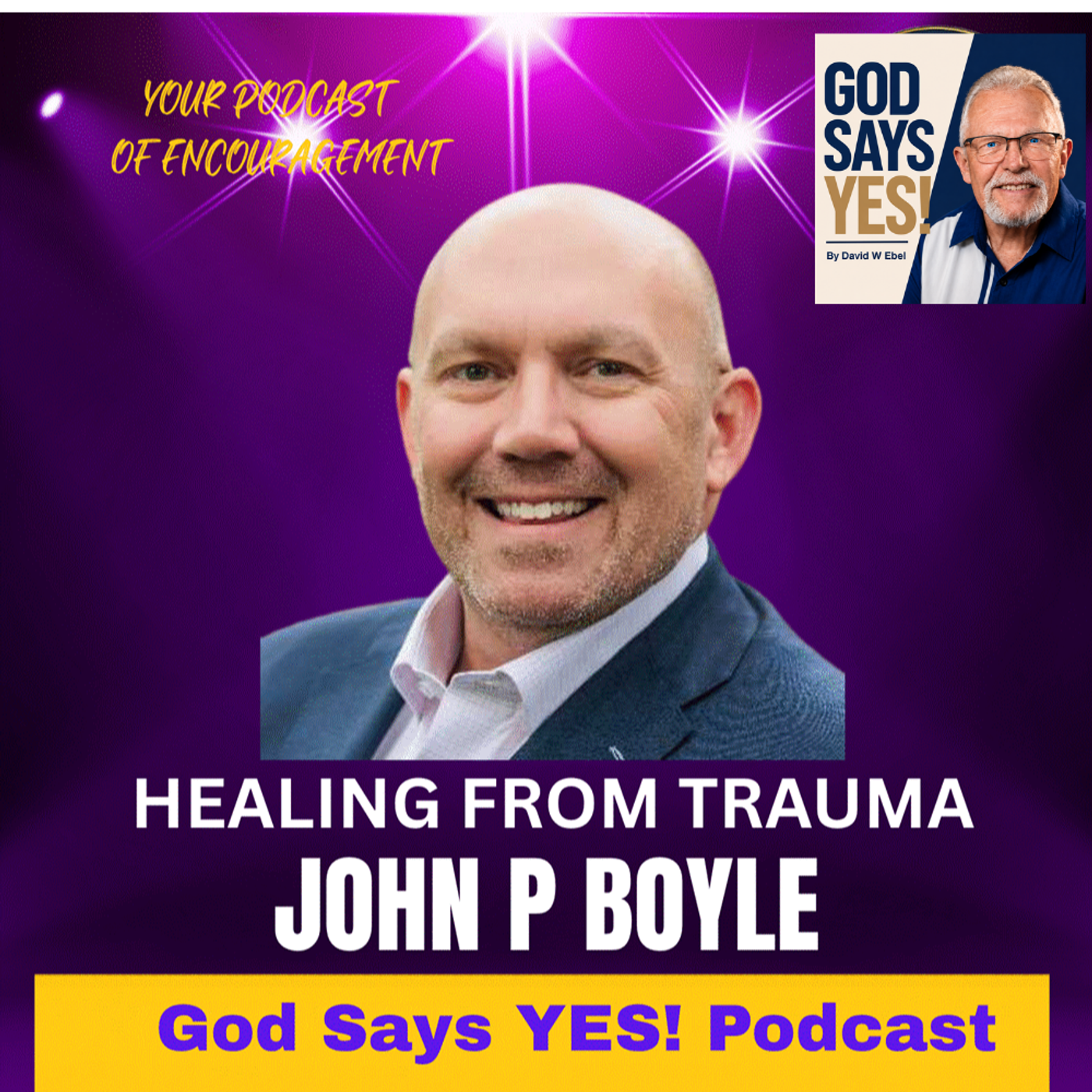
John P Boyle


 YouTube
 John tells David about growing up in coal country, and how God blessed him after he surrendered to God.
David W Ebel: Welcome to the God Says Yes podcast. You are welcome here. Hi, welcome. This is God Says Yes. I'm your host, David Ebel, and after fifty plus years of ministry, I still have a passion to reach people in their daily day-to-day lives, particularly people who struggle, regardless of how it is, whether you've been betrayed, belittled, â so someone's borrowed money and never paid you back, you've been hurt at church, whatever the reason is, sometimes we get wounded enough that we pull aside And we sit on the curb of of the road of life and watch it go by instead of participating, which is which is terrible. That's tragic. And â it happens, but it doesn't need to stay that way. â I think the worst one is church hurt, which â people don't realize that but â it when you when you go to church, it's a re it was designed to be the emergency room of the body of Christ, a place where the wounded could come and and find healing. And unfortunately, some of the people when you take â go to the emergency room, they're not coming in happy, they're kicking and screaming. And sometimes the people when they show up for church, they're still kicking and screaming. And somehow that splashes over on the innocent ones. And it's easy to retract and pull away and and to bl to stay out of church and everything else because of someone. But it's God isn't the one you you you you need to be mad at. It that was that person. And on p on behalf of the church, on behalf of the body of Christ, I apologize. That should have never happened to you. And if it did, someone should have ministered to you better to help you move past that so you're not stuck. But if you are, this is a place you can come and re receive an open door, no judgmentalism, no one looking down at you. Actually, we â we understand, we really do. And I know I've lived through it, and many others have. So we want you to come and and and to in enjoy the story. And â along the way, if if you find something in it that speaks to you, embrace it. Listen, because that's what we're here for. I have with me â a good brother, his name is John P. Boyle. John is is is a a force of nature. He does a lot of good things, and we have the privilege of having him as our guest today. So John, welcome. Thank you. Thank you for that introduction, David. â I'm honored to be on your show. And â yeah, it's just great to be here today. And â I look forward to this conversation and â wherever it wherever the spirit leads us. So tell us about yourself. Sure. So I grew up in West Virginia in a very small mining community, you know, adjacent to like the the border of West for â the border of West Virginia, Maryland, and Pennsylvania. And I grew up in a small blue collar town. You know, there weren't a lot of things for people to do as far as careers there. â Or â you worked in some ancillary field that supported one of those two. â farmers had a you know, I still have a very hard time making a living there, so typically your farmers work a second job. So it's a place that's very gritty. It it's a place that You don't make a lot of excuses, but at the same time it's very friendly. It's very inviting. If you would have a flat tire, multiple people would pull over. I live in Charlotte, North Carolina. You get a flat tire here, you better call Triple A, right? Yeah. So â wonderful people where I'm from. And, you know, I I I I was blessed to grow up in a community like that. And at the same time, I grew up in a home that was very violent. â I from my earliest memory until fifteen. Physical violence was a norm in my home. It came from my mother, not my father. â there was, you know, verbal abuse and neglect on top of that. And it was it was a very â challenging way to grow up. And I grew up Christian. My mom was Methodist, my father was Catholic. I mostly participated in the Catholic faith until I was in my mid-twenties. And, you know, I I I was someone who went to church. I didn't â complain, I participated, you know, and â at the same time I I didn't understand. I didn't understand the importance of faith. I didn't understand the purpose of religion because you know i i in in one aspect, you know, I was serving God and learning about Jesus and, you know, what the Bible teaches us and et cetera. And I I believe I grew up in a good Catholic church. But at the same time I didn't understand Not only why my parents would do this, you know, or let it happen, let let â physical violence happen in our home, â you know, I I didn't understand, right? And I didn't understand why God would permit it. And so, you know, now I don't have those feelings, but as a as a young person, as a teenager, as an adolescent, as a young adult, I really struggled with it. So there were a lot of changes challenges there in in growing up where I did. I can appreciate that. â my my mom grew up in on the in in a coal camp outside in Kentucky, West Virginia, right on the border. And my grandparents were all coal people. â wow. Small world, David. Yeah, yeah. Small world. Yeah. My great grandfather was a was a mule skinner. Okay. Okay. That's old school mining there. Yeah. That's for the people who are viewing, a mule skinner is the guy who would take the mules on the wagon into the coal c area. They would load the truck. Then he would he would have to motivate the mules to drag all that heavy weight back out of the mine over and over again. And and he would use a whip to do it, so they called him a mule skinner. That's right. But â so we j John, we have more in common than we even thought. We do. We do. Yeah. That's awesome. â and my my my mom was an orphan at age six. And so she was handed to whichever family member of s her her five her her and her five brothers and sisters. â could be had food. So he she understand she understand a lot of what you're talking about personally. Yes. It was not unusual to have violence in the home. Yes. So â well we're we're glad you're here and â but I we're not talking about my story, we're talking about yours. So â why don't you tell us â you know who you were before you you you found your faith sure. So you know I've shared a little bit about my childhood â you know, â around thirteen years old, I started working in in the family business. â my family when I was in junior high and in several generations before mine were coal miners. We were â my family was a coal operator. We had several small mines in in north central West Virginia. And so I started working in a machine shop at 13. â my family pivoted out of the mining business in the late nineteen eighties, early nineteen nineties. And started doing road construction. So really â in junior high and high school and through college, I worked building roads, water lines, sewer lines, â storm sewers, â asphalt paving. â that's what I grew up doing. So it was a very natural fit for me to go on and get a civil engineering degree. And then, you know, I ultimately I chose to work in the family business. And I think a lot of that came from my knowledge of the Inner workings of my family business was so robust that it didn't make any sense for me to go start over. I had been there eight or nine years before I graduated college. So I went into the working world and very quickly excelled, right? But there was this parallel path that was going on where my professional career was very robust and successful. I made â vice president by 25. Wow. I was actually the president of my family's business and CEO by twenty nine. And you know, that was kind of by default. My father got sick. He had a heart attack and found out that he had colon cancer in the same day. Called me up to the hospital and he said, I don't know what to tell you. Good luck, you're in charge. And at like nine o'clock on a random Tuesday, I go back down and I'm I'm leading the pack. And I I wasn't prepared, but we'll we'll get to that. That parallel path of, you know, I was very successful, I was very crisp in my execution of my job. There was this thing that was happening behind the curtains. â by the time that I was 15, â the le in the years leading up to that, I was someone who fought back against the physical violence in my home. Yes. I I took the approach that. If others aren't going to protect me, I'm going to protect myself. Even if I get my head kicked in, I'm going to fight back. And so that kind of led to me being removed from my home. I went to a boarding school at 15. I spent 10th through 12th grade there. I almost failed sixth grade. I almost failed 10th. I really struggled with symptoms and I didn't know what it was. I was disassociated by my surroundings by third or fourth grade. I would leave my home, but the war â was still going on in my own head, right? When I left for private school at fifteen, I had insomnia. I was having flashbacks during the day. I was my brain was trying to solve an equation that was not solvable. Why did this happen to me? Why do I feel the way I do? And I really didn't connect any of the dots either. I was just trying to go out and survive and you know, prop myself up any way I could to be something in life. And I had been told, you know, by my sixth grade teacher in a parent-teacher conference, she told my parents, I this kid's never gonna go to college. Right? Now, David, you know I have a degree from Harvard, but, you know, if I would listen to these people, I wouldn't be anything. I wouldn't be here. Right? So I was trying to put the dots together. And what I'm trying to explain is I had great internal difficulty As a result of growing up in a violent home, right? There were many issues beyond sleep, beyond flashbacks. I had a broken fight or flight response. â would make my heart race. I would have adrenaline shooting through my body, and it would feel like someone just called in a bomb threat, but yet it's like a random Sunday afternoon. And there's no reason for me to be that way. â I I had a lot of difficulties, â muscle armor. Chronic muscle tenseness, flinching, reactions to anything sensory. It could be a smell, could be a sight, could be a taste, could be a thought, could be a movie. It was maddening and I didn't know what it was. So I figured out in working in my family's business one summer that alcohol would take the edge off of these symptoms. â and it would allow me a break, so to speak. It would give me temporary euphoria. And â I used it to I use the terminology paint over rust. The rust being these symptoms that I didn't know what they were that weren't allowing me to achieve happiness or personal congruency from day to day, just having a a set lifestyle, right? Yes. So to kind of wrap up my point, in my early professional life I was very successful and regimented in my career from 7 AM to 5 or 6 PM. And when I got home, I had to drink to function. I had to drink to have any type of personal joy, to be able to check out of what had happened at work. And I used it as a crutch, as a crutch to get through to the other day, as a crutch to have a successful career. And The wounds were tallying underneath the surface, but I didn't realize that. And really by 27 or 28, I was going out and trying to get help. And I I just I was misdiagnosed for over a decade. So there were a lot of things that happened really from the moment I left home at 15 until I was in my mid-20s. By the time I got married at 27 or 28, had my first son at 29. That is when my world turned upside down. When I had my first son, you know, it started probably when he was one. I would just look at him, David, and I would I would ask myself, how could you be abusive? How could you be neglectful? How could you say the things that you said to someone that precious, to a blessing like that, right? â I'm not gonna let my son grow up the same way I did. Yes. I can't replicate that behavior. I have to be another person. And so really that marked a journey that went on for 20 years of trying to find a diagnosis for the unknown symptoms. I didn't even know they were connected until I went to rehab at 34. Didn't know they were associated with each other. It started a journey of me â wondering. those family members who were in my life, if they should continue to be in my life. Should I continue to stay at the family business and work? So I had a lot of inner turmoil â really in my early career that led up to me making ultimate changes in my life in my mid thirties. Mm-hmm. Then now that now now that we know how you got there, how did you meet Jesus? That is such a great question, and I love to share this with people. I met him in a bar. On a Saturday night about midnight. So here's how it went down. David, I was misdiagnosed with many things that I didn't have: ADHD, anxiety, depression, personality disorders, bipolar disorder. And, you know, in my endeavors to find a diagnosis for what was wrong, I began to take. SSRI drugs. I began to take sleeping pills. I began to take things for depression. And, you know, at one point in my early thirties, I was so checked out and lethargic that I just stopped. I stopped trying to seek a diagnosis. I quit and I used alcohol to cover everything up and function. I was an ultra successful alcoholic. And I I drank up to a bottle of vodka a day, some days. I drank every day for a decade, every single day, seven days a week, 365 a year, right? When I got to 34 years old, â my body began to break down and my liver refused to keep doing what I was making it do. my skin turned as white as the cabinets and shelves behind me. I went to my doctor, said, I don't know what's wrong. I can't keep food down. â He ran some tests, he â got my blood work, he you know, asked me a lot of questions, and basically what he said was your body, in particular your liver, is choosing to process alcohol and not vitamins from the food you're eating. You're malnourished, and if you continue to do what you're doing, it won't be very long before you're not here anymore. And I have to be honest with you, David, from From the internal challenges that I had had since childhood, from the lack of happiness that existed, from the just being burnt out of working and constantly battling these symptoms, I pretty much resigned myself to giving up. If I didn't have a seven year old son, his name's Jack, I probably would have quit there. Because when I heard that from the doctor, I tried to start quitting drinking on my own. Now, mind you, I had Drank for 10 years straight. It's not advisable to do that. You need professional help, right? I didn't know that. Doctor didn't tell me that. So I started just trying with my own willpower. And I would not make it until 7 30 PM, any night of the week. And so I had pretty much given up. I went to a bar with a friend. â I grew up with him, someone that I drank with and went to sporting events with. Great guy. We were sitting at a bar, it was around midnight, you know, we were having some drinks, talking, and just kind of minding our own business. And my friend Pat could tell that I I just wasn't doing well. And he said, What's what's going on, man? And so I told him. And â he looked at me, David, and â you know, after sharing what I did, he just said, Well, would you consider going to church with? And you know, my first response, David, was was to kind of laugh and say, You go to church? Right? And then I felt this feeling that came over me. And the I have it right now. It's it's this feeling of like all the hairs not standing up. They're like standing at attention. All the hairs in my body, my legs, my arms, everywhere, right? It's like chills, but it's a good chill. It's like, no, there was a reason and there's a purpose. And if you're ready to â give your life to me, let's go. And I could feel it. Like I just I had these thoughts in my mind as I'm looking at my friend sitting there and you know, listen to Johnny Cash on the jukebox. And it was just like, you know, you know, God is infiltrating your drinking buddies to get to you. I had been invited to this church, he invited me to by my sister, by my brother in law. By a vice president, my right-hand man at work, and I told all of them no multiple times. But this setting, with these circumstances at this particular time, that was the catalyst for change. And that was my lifeline. And, you know, in a few seconds, I'm sitting here processing this. And, you know, beyond asking him if he went to church, which I don't think he even answered, â you know, I just began to think like. Boy, if I don't take this lifeline, will I be given another one? And then I began to think, David, you know, and I I've heard this a lot in recovery, but I don't know that I necessarily agree with it. You have to want to change yourself. And I didn't want to change. I wanted to do it for my seven-year-old son. I didn't want him to grow up without a father. I didn't want him to grow up handicapped in some way that I could prevent. And so I just looked at my friend and I said, Sure, Pat, I'll go with you. What time? And I went. And I I'm sure I reeked of alcohol. I'm sure I was hungover. â I'm sure I was nervous. I don't remember that nervousness now, but you know, I just remember like walking in the doors, and you know, it had been a decade and a half, maybe, since I'd been to church at this point. I just remember walking in the doors, feeling or expecting to be struck by lightning. And instead being struck by the peace that existed in the building. And it was just such a a 180 for me to have this peace come over me. And then that is ultimately what made me want to go back the next Sunday. It's not that these problems went away in a day. I didn't show up to church at 10 a.m. and it was over at eleven. I'm like, you know, wow, all these things have turned around. No, it it wasn't that. It was more of like a planning of a quiet promise that There's purpose to your life. And I and I've called you for a reason. I didn't hear that. I felt it, David. So I went back the next Sunday and the next. And ultimately I gained the the internal fortitude to agree to go to a rehab facility to get help. And the night before I left, I prayed to God, which I had not been doing much of. And Was similar to the story that you kind of gave me before we got on the air. And it was just, you know, God, if you're there and you care and you want me to do this, I need you to take the urges for me to drink away. I'm done with it. I promise. Just help me in that regard. And he answered that prayer the next day. I've been sober thirteen, going on 14 years by the grace of God. Not only have I not drink and drank a drop, but I haven't wanted to. Right? And the first day, the first hour I was in rehab, you know, I was given a medical and psychological evaluation, and that's when I was diagnosed with complex post traumatic stress disorder. I finally knew what battle I was fighting. Now I needed to figure out how to win. But I knew that there wasn't any equation in winning â unless I brought God into the picture. And that's really when I leaned into â faith and faith became that ultimate catalyst for me to be where I am today. And it's night and day compared to where I was. It's like a line a line drawn in the sand, and you on one side you're looking at it, then you finally try it you you step across that line and you and you become a part of it. So it's not just getting it here, it's getting it here in in your heart, in your life, and it you you absorb it, it becomes a part of you. That that God tells us he's given us a measure of faith when we're born. There's already a piece there's faith there. He finally gets to to â anoint it, if you will, to to charge it up, to to get it off the nine volt back backup battery and to get us charged up to trust him, to yield to him, to to and to say, I don't care how crazy this sounds, I trust you. Yeah. Because obviously everything I've tried has been a failure. So why not try something new? Maybe like something you did and and and and ask God to help and watch what happens. And obviously your story is is profound, how much it changed. It's so well said. That's so well said. So now you've you've you've you've met him. He's begun the journey. What happened next? Well, Three experiences in rehab for alcohol addiction really changed my approach to how I viewed staying sober and what I needed to do to catapult myself, like the decisions that I needed to make about what I was doing in my life to catapult myself to a place where I wasn't trying to run the show. Like I needed to get off the stage, David, you know, and and let God take it over. But it it didn't go that quickly. â I was given a couple of examples early on in alcohol rehab that changed my viewpoint of the habits that I needed to develop to stay clean. â the first day, second day I was there, there was a party for a gentleman. Who had worked a career in very successful career in investment banking. He was a graduate of Oxford University in England. That's a huge deal. Bigger than Harvard. Right? He was someone who ran a global investment bank. And David, he had been in there for ninety days, right? He was retired. He's trying to quit alcohol. He leaves after ninety days. Place throws a big party for him. He lived three blocks away. He made it two blocks home. He didn't make it home. Towards home. He went two blocks. He went to a place called the Drunken Goat. He got hammered. And he was back in that rehab facility before dinner. That was example one. Example two, there's a pilot that comes in. Huge guy, six seven, six eight, big â frame. He walks in with his two boys who are probably five and seven. He yells right in front of me. Is this where all the drunks hang out? I'm like, man, what are you doing? The guy falls into the bushes. His kids are in tears. â nurses come out from the intake facility, bring him back in there, and like three minutes later, cops, the fire department, and an ambulance come and pick him up and take him and his boys to the hospital. So I go down for breakfast the next day, and he's sitting there eating an omelet. And I'm like, dude, what was all that about? He said, I blew a point four five in the breathalyzer. I should be dead. So they took me to the hospital and pumped my stomach. So what were you doing that you were that drunk? He said, I was I was â on a plane from Germany. So did you drink the bed fridge car drive? He said, No, I flew the plane. Yeah. The third example was a childhood actor who was older than me. â he's deceased now. And he had fought alcoholism his entire career. He didn't have a career left. â and I'm not gonna mention his name, but he really struggled. And you know, maybe like third or fourth day I was there, he left a group meeting in tears, went across the street to a bar, got drunk, fell asleep. Trying to get back to his room on the stairs. They kicked him out the next day and he was back in a couple weeks. What I'm trying to explain to you is I saw rocket after rocket explode on the launch pad and not get off. And everybody was there. Everybody who was there, it was, they, they had made all made multiple trips to rehab. I was the only one who was like a first-timer, right? And I just knew like I cannot take an approach that it's gonna be my willpower that keeps me sober. â yeah. So after after the third example, I picked up a book called The Bible and I turned to the book of John only because my name is John. And I read about one column of one page in the old King James Version and just couldn't I just couldn't keep reading and making sense of what I was reading, right? I was on a tranquilizer and they were trying to get me clean. And that's that's what happens when you go into rehab. They put you on a tranquilizer because it tricks your mind. That's a it's a replicate and allows your body to kind of â bounce back from the amount of alcohol you've given it, right? And it takes the urges away. So â you know, I remembered after putting the Bible down a couple of times, not being able to read it, I just prayed, like, God will you help me? And the next day I remembered that the church I'd start going to, they film their services. You know, this is fifteen years ago, fourteen years ago. So I don't think it was as common as it is today. Especially post pandemic, right? So I went on the website and just found sermons. Said to myself, Well, I may not be able to read, but I could listen, right? And so I just listened to sermon after sermon. It was like it was like the pastor was talking right to me. And, you know, I I began to understand the life that God intended me to live. I began to really truly understand for the first time the actual sacrifice of what Jesus Christ really did for me. And that it was for me. And it wasn't just generally for everyone, even though it is, â that it me should mean something to me, right? I began to understand what redemption and salvation were. I began to understand how we were intended to live our lives. And that's when I began to really lean in, and it wasn't a crutch. It was the only solution I could find. And by the grace of God. I haven't wanted to drink, I haven't taken another drink, and I've been able to, you know, focus all my efforts on a mental disorder that I didn't know I had until I was thirty four years old. And now I've learned enough that I I take that knowledge and I give back and I try to share any chance I get. It's it's not only to have kingdom impact, but it's to reach back and help those who don't yet have answers, don't know what battle they're fighting, and they sure as heck don't know how to win. Right. So how can I prevent the same experience of misdiagnoses for over a decade that I endured? To help others to not have to have that. Yeah. That's profound and and I'm thank you for being so transparent. Yeah. It's â f for for those who have not had to to be this transparent, it it takes a little courage or a lot of courage actually to to to say, This is me and this is really me. And no excuses, no you know, I can't rationalize this out. This is just what's really happening. And you know, I I was gosh I I I was ADDHD before they had letters for it. And I I didn't they did my my report cards used to say David can't pay attention. David's always looking out the window. He can't stop talking. And you know, I didn't know. I got punished. They sent me home. My mom sp would spank the daylights out of me for it. â because, you know, sh she'd been abused so hard that her version of she had softened the punishment to what she thought was reasonable. But none of my friends ever got beat like that. And it wasn't experience was the same. Yeah, and she she loved us incredibly and it was not but until she got angry and then all the flashbacks of all the abuse she had would come back and then she tried to filter it down softer and then we got our dose. But we still got several doses at once. Yeah. And â you know, then so through my life we've had We've discovered I have â PTSD and a bunch of other letters that they they put they throw behind your name. But the the reality of it is I am not who I was. Yes. I am who I am today because God chose to do something with my life in spite of the being lied to and cheated and betrayed and and and abused in in uncomfortable ways. Yeah. â I am not who those people thought I would be. I'm not living their life. That's awesome, David. That's awesome. You're not you're not who they thought you'd be because God gave you a whole new you. It's night and day. When you look at my life before Jesus, before God interjected, and you look after. I mean it's not even close. It's not even close. It's not I there have been so many unexplainable things that have happened in my life since surrendering. â I I could sit here on your podcast and talk about it all day long. Doesn't make any sense. Here's a question for you. How many times do you surrender? I I think it's an active verb. â I think that we as humans are innately prideful. And if we're not careful every single day, then we can make decisions that are based on pride and not about service. And I still catch myself doing that. And sometimes it's intentional, sometimes it's not. Yeah. I I discovered that choice is the big challenge for me. Mm. I because I have to choose to love my wife every day. They've been married fifty-two years, but I still have to choose. Yes, you do. â I I I have to choose I live in chronic pain. I've been in pain since I was six. So â I have to choose to get out of bed in the morning. Some days are a little easier than others. Some days are absolutely horrible. â I've had â I can't if I get four hours of sleep a night it's a good night for me. I I'm not quite there, but I'm close. And I'm so I you know â the I my choices are the harder the day is, the more I choose to to bury myself in Jesus and to do more to give him glory than a on an easier day. Mm-hmm. He he I'm not giving up any ground. I refuse to go backward. For a guy who's tried to kill himself five times, b you know, set people say, Well, don't you want to go back? Well, just give me the gun and I'll finish it now. You know, there's nothing to go back to. It's like diving into a sewer with without a helmet. You know, it's just like here I go. But you don't necessarily know that, David, until you experience life another way or life that can be better lived, right? That's And that does come from someone. Fortunately, I wore myself out. Trying to fix my own problems, right? So I I think the surrender part to me was an easier choice, given the fact that I'd worn myself out. That the the the hardest choice for me, and I've gotten there over time, has been forgiveness. You know, I used to think of forgiveness, you know, especially early on in Christianity 10, 15 years ago. I used to think it as like a cruise control. Well, you just do it one time and you just kind of set it and it keeps you at 70. No, it's an active verb. You have to choose forgiveness every day when hate creeps in, when â the lack of understanding creeps into your mind, when the devil uses as a as a foothold to get in and mess with you. You know, those are the those are the type of decisions that I think are harder for me, the forgiveness part, right? Not holding a grudge, not harboring hate, not defaulting the wrong way, right? Moving forward. Blame. Blame is a huge one for me. My my my own sons have caught me and said, Dad, you're doing it again. And didn't even realize I was doing it. Because it's it's been my it's been my go-to since I was born. Understand. And you know, I'm I'm better and I'm I'm I'm incredibly better. But that doesn't mean that if it's hard that I I I don't subconsciously fall back and I have to stop. Yeah. Ask God to forgive me, forgive myself. Then get up out of the mud and do something about it. That's right. Mud don't taste good. You don't have to eat it twice. You know what? When you realize you're doing it, you stop. Well said. one of my one of the comedians I used to love listening to, he used to say, you know, when people get when they when they when it's about Jesus They you know, if they don't choose it, it's it and they've been eat they've been doing the wrong thing. They've been eating green bolognay when God's got offering prime rib. Why in the world would you keep eating green baloney? And the answer is because they don't know how good good is. That's right. That's right. And I think that's a big deal for for you, for me, and for our viewers too, and our listeners. â it doesn't matter how what got you to where you are. Agree. It matters what you're gonna do today. Agree. And and by today, choosing a path that will make tomorrow a a livable. Not great, but livable. Good enough that you're willing to wake up in the morning and try again. I think it helps those people. I know it helped me when I understood from others the impact that faith had had on them. By sharing your story or testimony, â that can be effective in and of itself, right? To us humans, trust is transparency over time. And a lot of humans, you know, â Thomas is a good example in the Bible, right? He was kind of a doubter and, you know, he he needed to reach into Jesus' side to understand that when Jesus came back after being crucified, that it was him. That wasn't a joke. Right? And Jesus said it, that's okay. Touch my side. Just so you know. Right? And And th those like like that's why it it it is important to lean in and read the Bible and understand that Jesus is not expecting perfection. He loves you and he wants you to learn over time. Understand the difference between right and wrong in his eyes as he's taught it, then you can try to apply those. But everyone I think struggles with that and gets better over time, even though We don't admit that many times to each other. Right? â yeah. It's back to being innately prideful individuals. Well, sometimes the only the we survival has been controlling your situation. You know, if if if I walk in a room and things aren't good, I leave. If you know, I find an excuse, I find a an escape when God's answer is don't run, it's let me fight the battle. Let me be in charge. Let me lead and guide. And if it if it's tough, just hang with me. It's it's tougher today, it's not tough for the rest of your life. Even now after fifty f fifty plus years. I still have to â when I get up in the morning, I choose Jesus, I choose my wife, then I choose whether I'm gonna get out of bed. And I have to c and throughout the day I I I probably choose fifty times a day. And you know, I mean that's not like God do I do I want more butter on my toast. That's not the kind of choice I'm talking about. I'm talking about how how my purpose is going to be. Right. How I'm going to interact with people. If I'm not feeling good, do I want to punish the other people or do I want to realize that they have nothing to do with how I feel, but everything to do with how they're going to respond to me. If I give God a bad name because I've I've been a jerk. You know, I move on, but the their their experience of of who God is through me continues to play in their head. Yes. So I need I need to choose that when I have a bad day to go do good things so that I could outweigh the that initial feeling of misery with with something good, something valuable, something that someone could take home at night and say, you know, that that David's not a bad guy. Instead of what a jerk. And and you know, and both of those people could be there. Yes. But you know, I I don't want God to have a bad name because I've been a a crummy servant. I agree I want I want God to get a good reputation in spite of me, not not and you know, because you know I'm I'm still me. I am too. And â but that's okay. That's right. And â and if I if God doesn't punish me. I need to stop punishing me. It's hard to give yourself grace when you come from a place of constant adversity from a young age. It's a challenge, but it doesn't mean you can't do it. You're recognizing it and you're trying to get there. Yeah. Tell us more. â so after getting sober, my life completely changed. â I returned back to my old job. And I worked there for another two years. I had been there â no, I'm sorry. I worked there for another three years. I â Within twelve months of Getting clean, I met a gentleman on a beach who came up to me in a wheelchair. Have you ever had a guy come up to you in a wheelchair on a beach, David? Because I've never even seen a wheelchair on a beach, other than this experience. This guy comes up to me and he asked me what I'm reading. He asked me why I'm sitting on the beach reading at five o'clock when everybody from my group was at the bar at happy hour. So I told him. And the guy said, Well, what do you do? And I told him what I did. And he started asking me about my company that I run, my family's company. He asked me about, you know, what age I had started doing that, how old I was now. And, you know, maybe after 15 minutes of small talk, I'm like, I'm wondering why this guy's asking me all this stuff. He looks at me, he says, Have you ever considered going to Harvard Business School? And I literally laughed in this guy's face, like busted out laughing. Right. And I'm sitting on a towel and he's sitting in a wheelchair and I I regret doing that. And he looked at me and he said, Do you do you like this? You know, kind of nodded his head and smiled. He said, Do you like this island we're on? I said, Yeah, I really do. He said, That's good, it's my island. â When I tell you when I give you a piece of advice, I I hope you'll listen to what I'm telling you. Get on Harvard's website, download an application. For a program that fits you, fill it out, put my name at the bottom where it says referred by. My name's David V. Johnson. I'm from Detroit, Michigan. Now I've never met that guy before, never met that guy after, right? I go home and I'm like, man, I can't even spell. I'm gonna f I'm gonna fill out an application for this school, and they're gonna turn me down, right? But I filled it out. made sure that my spelling was correct and kind of forgot about it. Two weeks later I got an email saying I was accepted. And I was like, I was in Pittsburgh at a hotel, you know, about to go to a work function when I found this out. And like I'm literally running up and down Liberty Avenue with my arms up in the air, like I'm Rocky Balboa about to fight Apollo Creed. I was that happy. And it's like, you know, I was told I would never go to college and I just got into the hardest school in the country. It was that me or was that God? I'd argue it's the latter, right? So I'm like, all right, well, I just got in. Now I gotta figure out. You know, I got an eight-year-old son. I gotta figure out, or nine year old son at that point, I gotta figure out how I'm gonna go to school and be in Boston a month, a year, and run a company and be a dad. We figured it out. â while I was in Harvard, I was in a family business class by a by â the professor was a guy named John Davis. John's at MIT now. And â John asked the group a question. And I raised my hand and answered and, you know, kind of â gave him like the the old school Paul Paul Harvey, the rest of the story type answer to his question. And he was kind of befuddled by my response. So I ended up my story ended up monopolizing a class segment about the difficulties in family business and in particular why generational family businesses have a difficult time. Handing the baton down the bloodline. And I used my ex story as an example. Well, when you come from a violent home and you've worked in the family business, you you know, you have triggers and flashbacks and nightmares about maybe what mom or dad did to you, but you see family business a little bit differently, right? And and so, you know, it it ended up interesting a lot of my classmates. I was told after class by several of my classmates, you really need to write a book. John Davis, the professor, told me the same thing. And I'm like, no, I'm an engineer. I'm not an author. Don't give me that stuff. That's not happening. And one of my friends, Thomas Wiggleman, who lives in Munich, Germany, â just continued to to hound me about it. Not hound me in a nice way, right? How are you doing on the book? How's the book coming along? Nudging. Every time I talk to him, he's on this book. And I'm like, You know, I actually took my oldest son to go see him maybe 2016, my after my second year at Harvard. And, you know, Thomas took us out in Munich and we went out on a lake on a boat and he just wanted to talk about my book and why I'm not writing it. And and he just wouldn't let it go. And so when the pandemic came, that's when I felt the calling to write. And so I wrote my first book, Appalachian Kid. Had no idea how to write a book. When I got the calling, I went to my pastor. â I went to two pastors, both at my church. I went to the second pastor because I didn't like what the first one told me. I had gone into the first pastor and I'd said, â Josh, I feel this calling to write a book and I don't want to write it. You know, you you understand the misgivings when you start talking about growing up in a violent home and your family's still in successful business, when no one outside the family really knows these things. You're putting yourself out there. And you do not know how it's gonna be s received. My family might sue me. I may never get another president or CEO job because now I've I've come out as having a mental disorder. Am I gonna s be seen as crazy? These were my worries. So I when I went in and talked to my pastor, he just said, Well, if God's calling you to write a book, I'd recommend you write the book. He didn't say go publish a book. He said write the book. So go write the book. And I'm like, Okay, all right. But I'm gonna go see another pastor, my buddy Bruce, who was in my small group. I'm gonna ask him the same question. He gave me the same response, right? So during the pandemic, I wrote a book. I really didn't think anyone would buy out or read it. I didn't know if I could even get a publisher. So when I finished it, I had met, I I had moved to Charleston, South Carolina, because my youngest son, I was remarried, had a son. And he had autism and we needed to go and get him better care and it wasn't available where we lived in West Virginia. So when we relocated, I only knew one person in Charleston. It was a woman who had gone to Harvard and she knew my pastor back in West Virginia. So she introduced me to another author. And I sat down with him on a Saturday morning, showed him one of my chapters. He reads it. He called his publisher on the spot and he said, Jeremy, you've got to see what I just read. And I'm telling you right now you need to to publish this guy's book. I was told it'd be two years to get a publisher. I was on day two. And by day three, I had a deal in my inbox. You know, that's again, that's not me, that's God. Right? I can't take credit for anything that happened after I got sober and surrendered. So I get a book published. I'm thinking nobody's gonna read it. Right. First day it's an Amazon bestseller. Within the first week, I had a flood of emails, messages on LinkedIn, â texts and calls from people I knew. Hey, I've had this experience too. Or I'm struggling in alcohol, what do I do? I've had a lot of moving conversations. You know, some have not made it. Some have chosen not to surrender, not to get sober and aren't here anymore. But there's there's some stories that are so so good. And I had a guy from Amarillo, Texas reach out to me. And it went like this, David. â just heard you, I was on a â an iHeart radio interview in Houston, Texas. And â it's called Courageous Christianity. And this cattle rancher in Amarillo, which I've never been to. I've never been to Amarillo, I don't even know where it is. He calls me up and he says, My story's eerily like yours. I'm struggling with scotch. I'm about to lose my my wife. I'm afraid I'm gonna lose my kids and I'm gonna be dead. He said, I heard you on this radio interview. I bought your book, I've read it twice, and that was two days ago. Will you help me? So I was driving through Georgia doing work and just pulled over and prayed with them. And, you know, now when I hear from them, it's hey, I'm a thousand days sober. Or I'll hear from them at Christmas, hey, Merry Christmas. Thank you for helping me. That made it all worth it. To be a blessing for someone else to Share your story and keep others from experiencing the hurt that you have. It's a blessing to your soul. It it gives you purpose. And through that journey, what I've really learned is like God brought me through something I didn't understand. For years, I didn't think God was there. He was there. He understood. He saw it. But I had to experience that. To be able to do what I'm doing now for what I was called to do. So when I look back on it, I don't look back with hate anymore. â I look back at it as I had to experience this to do my job. Mm-hmm. And that's all it is. Yeah. That's all it is. So I need to go do my job. Exactly. I see that I have my history. Which is how I got here. I have my experience, how I found God and began, and now I have my today and my tomorrow based on those two things. I am not those things. I am not my history. I am not who I was the day I gave my life to Christ. I am who I've become because of those foundations. So I need those things to do my job. Yes. But it's more than my job, it's my joy. I love it because I know that God is happy with me. I'm doing something He wants. And I I meet so many people who come to me and say, How do I how do I know God's will? What are you doing right now? Nothing. Well that's a good way to not get it. You know, the Bible even tells us whatever we our hands can find to do, to do it is un with all our heart is unto the Lord. And which doesn't mean you have to have your job description and your your first six chapters and and and and He means, okay, God, you you've right now you've got me filling food bags at the food pantry. Well, I'm gonna make the best food b baskets you can imagine until you tell me what else to do. And I'm gonna love you out loud with that. Whatever it is that â is my chapter, I need to do it with joy, and I need to do it as l loving God out loud, which is what you're doing and which is what I want what I want for our viewers. I want them to get to a place where their history is just that. It's it's the foundation from which you build your new house. Well said. Well said. I have a business mind, so I see it as â more of like a parable of talents, right? I the parable of talents is in two of the four gospels. â yeah. And â you know, I I look at it and I share it with people at work all the time. You know, you you don't have to have it all figured out. You just have to apply effort and and understand where where your Strength comes from, right? But but God wants a return on those talents. And sometimes He does give us the freedom to do those things. And â you know, I wish in retrospect I would have been looking at the opportunity to write a book as a development of a talent I didn't know I had. Had I have never tried and made the effort, well, â I wouldn't have gotten there, you know, and it it doesn't mean that like it was easy to write the book. I wrote it three times. My first one. And I had to throw the first two away. And you said something before this interview that made me think of it. You know, I I felt like I owed God my best. And when I got done with my first and second copy of the book, I didn't feel like I was there. And I had to admit that to myself and slow down and go through the process again. â here we go. I got to sit in the basement for round three. But I didn't take it that way. I took it as, okay, what do I need to do to get better? How can I better develop myself? Exactly what outside resources can I use? Who could I know that's written a book before? Right? These are the things. And you know, another one that came into â Stephen Covey is a wonderfully intelligent individual, right? When you read the seven habits of highly effective people, â one of his seven habits is begin with the end in mind. And my biggest problem in writing my first two versions of my book was not that I didn't know how to write. My book my challenge was I didn't realize I was just telling stories. And I needed to figure out which story I was gonna end my book with so I could tie everything I was writing to that. So amazing. Yeah. Amazing. I I love it. â we have it's it's like we've known each other for years, John. I mean, we have so many things in common. It it it's just kind of it's gotta be a God thing because there's you know, â my dad carried a I gave my dad a card who still was not a believer till the very end. â but I gave him this card and he carried it in his wallet. When he died, my mom handed me his wallet and this card was in it. It said, Coincidence. When God moves and doesn't get credit. I â had a Navy SEAL write the forward to my first book. And he was one of the first speakers I heard at my high school when I left home that really, you know, he talked about overcoming adversity. He's a big Christian, and he's a Christian because he saw things in war that didn't make any sense. And he knew at a certain point during his experience that God was absolutely real, and he leaned in to learn about it. I talked him in. And had to have his brother help me talk him into writing the forward to my book. One of the things he writes is the co and coincidence is God being your co-pilot. And it's so true. There is there is no such thing as a coincidence. I do not believe it. No, we're just we're looking in the wrong spot. Yes, sir. Well well, John, â when we when we do our our interviews, we always invite our guests to leave us a golden nugget. That nugget would be â â you know, what you want people to mull over and do and develop and and w over the next w â week or so. So â I wanna talk about your book, but when we're done with the book, you know, I I want you to leave a golden nugget, something that people can, you know, whether they pray over it or they meditate over it or how how they process it, something that's gonna give them give them hope for the, you know, in the the weeks to come. So â let's why don't we take a minute and talk about your your Yeah, you you mentioned your books. You wanna tell us the names of them and how they can be â achieved? Sure. So â the first book that I published in twenty twenty three was Appalachian Kid, and the subtitle is How Hope Changed Everything. It's a memoir about my life from my earliest memories until maybe forty, forty-two years old. I'm forty-nine now. â so that book â really it it's I've been told that it's a fun read. â the people who have given me feedback, readers, friends, acquaintances, pastors, â they have kind of shared with me that that the book has taken them up and down. It'll make them laugh, it'll make them cry. Obviously, you know, you know, when you talk about â domestic violence, child abuse, things of that nature, they're not fun things that people just strive to read about. And so, â You know, what what readers really learn at the end of that book is the book isn't about me, even though it is my memoir, even though I am the vessel that goes through the book, the book truly is about those people who helped me, my lifelines. â my high school football coach, my teachers, my father's best friend who used to take me hunting and fishing, spend time with me. â the book is about â My best friends in this world. And â you know, one of them I write, you know, my my my last chapter is is about them, right? I I go through name by name. And, you know, one of them, you know, is when you grow up in a violent home, you don't want to fight when you get to school. Yeah. But I grew up in a very impoverished area in West Virginia that was rough. It's a good place, but it's rough, right? And â I had a A friend growing up, his nickname's Moose, he still goes by Moose. He was a bigger guy than I was. You know, he in junior high used to used to walk me from class to class so that I wouldn't be bullied. These are the things that I show at the end of my book, right? That when I look back on my life, I show my life before Christ, I show my life after Christ, but I also give a reflection back to my childhood and how I grew up. And I I tell the readers that God was there. He was there. And what I'm trying to embody is hope, period. And when you look at hope, there's two definitions. First one, you look in any any dictionary or you just Google. The definition of hope. You're going to see how the world sees hope, not how the Christian faith sees it. You'll get a lot of nice words â to desire or want something to be true. But essentially every definition comes down to hope is wishful thinking. Well, David, I hope you have a good day. I hope it doesn't rain for you. Hope your technology hangs with you enough that your face doesn't freeze up during this interview, right? â that's how the world sees hope. When you look at biblical hope, it's much, much different, right? â scripture tells us in Hebrews that hope anchors the soul. Hope anchors the soul. But what does that really mean, right? Well, I know a soul, I have a soul, but why does it need to be anchored? Well, it's not necessarily anchored, right? When you look at the â some of the words that were used in the original like Greek terminology, â what an anchor means is an attachment. Right. And it and scripture refers to it being an attachment to God. In the New Testament, hope â morphs into being a confident expectation that â God's promises are true and they come to pass. Right. Meaning, like if you look at some of the old testament books, like Isaiah, if you read Isaiah 53, 5, it says, For he was â crushed by our â he was crushed by our inequities. â Pierce for our transgressions, the price that brought us peace was on him, and by his stripes we are all healed, right? Well, a lot of people don't understand that was written like four to seven hundred years before the coming of Christ. Right? So God is telling us his promises in the Old Testament, they come true in the New Testament. He has proven himself, right? So hope to a Christian is a confident expectation that God's promises are true and they will come to pass. Amen. So the essence of my book really is about that. And I show it through my life that I've lived. Now you go ahead. You have a second book? Yes, I have a second book. It's Invisible Wounds. â it's a micro book, so it can be read in two hours or so. And it's really a deep dive into â being able to understand complex post-traumatic stress disorder, and it's also about healing from it. It's been my experience of how I've healed, and a lot of it is related to Christianity and how I've used Christianity to overcome adversity. Wow. And so I I'll have a third book coming out about hope this fall. And do you have a website that we should be looking at? Yes, sir. â John P. Boyle dot com. It will give you an overview of my story. It'll give you a synopsis of both of my books. It'll give you some testimonials from readers. And it also has my website has all of my â previous â media engagements, podcasts, television, radio interviews, things of that nature. Awesome. Now it's now it's time for the golden nugget. â the golden nugget. So I I I say this in my interviews, â speaking to those who have had the same experience as me or you. Right? Childhood adversity. And â if you haven't if you've had experiences similar to mine growing up, â if you've ever wondered why am I like this? Why do I react so strongly? â why can't I get over the past? Why do I shut down? â why do I feel unsafe even though I am safe? Why doesn't anyone understand what I'm going through? Then the book Invisible Wounds is for you. And my golden nugget is this that healing is possible, hope is real, and you deserve both. Wow, that's that's deep stuff. That that'll that's and something to mull over. â I I hope people will even play it back and write it down because it's that good. â I hope so too. So w w as as what we'll do now, we're going to close in prayer. Heavenly Father, we're so grateful for this privilege that we've had, John and I, to to just to share your love. To to to, if you will, brag over how good you've been to us in spite of our experiences. How you've been there through our hardest times, you've given us grace through the the challenges, you've given us hope regardless of the situation, and you've and you've given us a future, a future that we look forward to living. Lord, we ask that you bless the viewers and the listeners, that as they listen to this, that it would speak to their hearts, that it would make a difference in their lives. And Lord, please â anoint what's been said and let it make a difference in lives to the glory of God in Jesus' name. Make that difference real that people can actually say, as of today, there's a difference in my life because I use the faith that God gave me. Heal them, Lord, and bless them and restore them and rebuild them and reinspire them for your glory in Jesus' name. Amen. This has been the God Says Yes podcast with David Ebel. Connect with David, email him at Godsays Yes Podcast at gmail.com. You can get his latest book, When the Doctors Say No, God Says Yes, at Amazon.com.


